Why Eyes Are the Hardest Part of a Realism Portrait Tattoo — And How to Get Them Right
There's a moment when someone looks at a realism portrait tattoo and something clicks. The piece stops looking like ink on skin and starts looking like a photograph, a window, a face that's actually present. Nine times out of ten, that moment is driven by the eyes.
And there's an equally familiar moment when a portrait tattoo falls flat — when the subject looks vacant, or off, or just not quite right. Again, almost always, it comes down to the eyes.
Eyes are the hardest thing to tattoo in portrait realism. Not the most technically complex in terms of shading volume — a full back piece or a detailed sleeve involves more total work. But nothing exposes an artist's weaknesses faster, or more unforgivingly, than a pair of eyes.
Here's why.
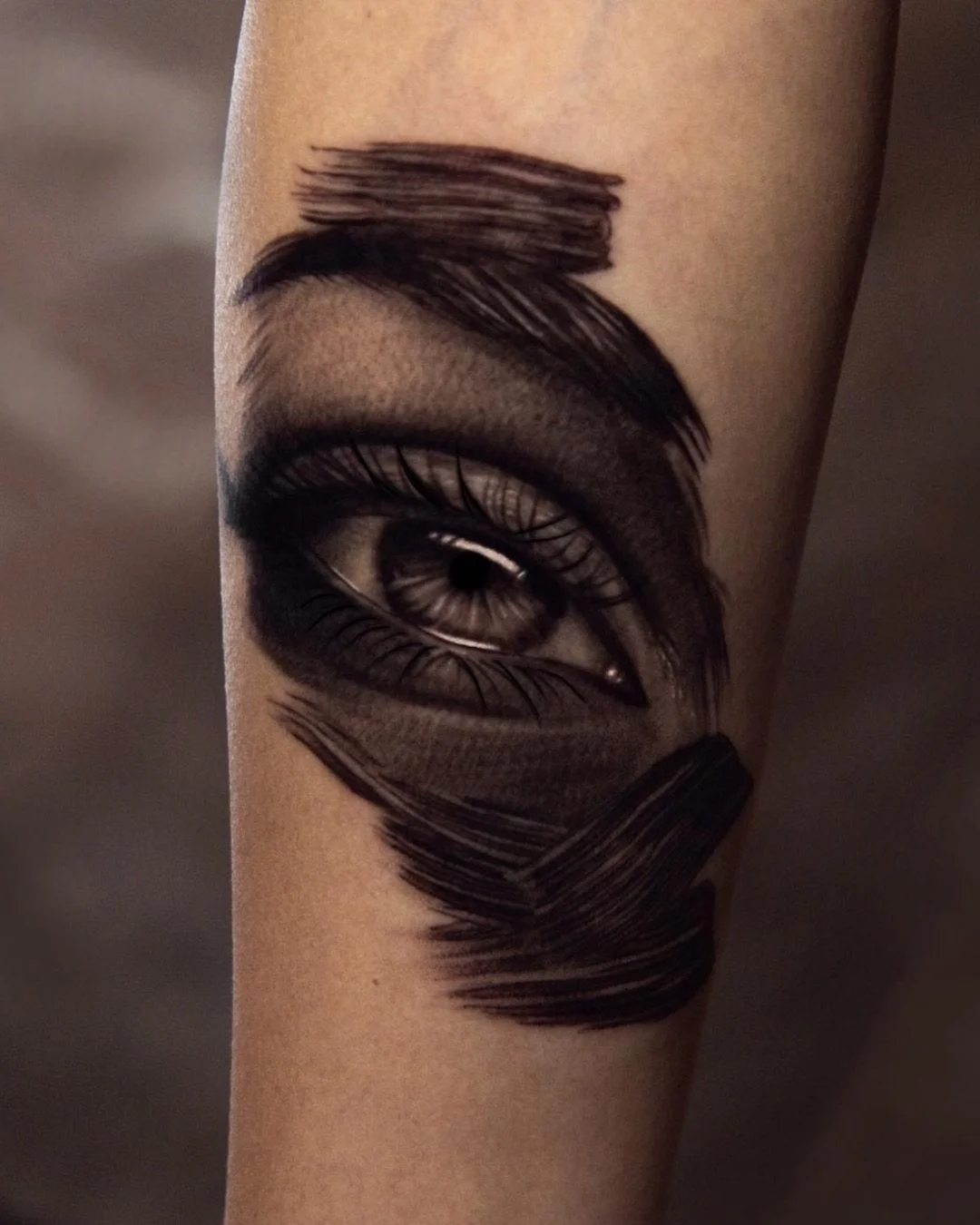
Realistic black and grey eye tattoo with bold brushstroke texture on forearm by Brian Parrillo Durham NC
The Human Eye Is Wired to Detect Errors in Other Eyes
Humans are extraordinarily sensitive to faces, and especially to eyes. It's hardwired — we read emotional states, intentions, and identity through the eyes before we consciously process anything else. This means a viewer doesn't need to be an art critic or a tattoo enthusiast to know when something is wrong. They just feel it. The eyes look dead. The eyes look flat. Something's off.
That instinctive reaction is the challenge every realism portrait artist is working against. The margin for error is essentially zero.
What Actually Makes an Eye Look Real
A convincing realism eye is built from several layers of detail that have to work together simultaneously:
The catchlight.
That small, bright reflection of light on the cornea is what gives an eye the impression of being wet and alive. Its shape, placement, and intensity have to be precise. Move it even slightly in the wrong direction and the subject appears to be looking somewhere else. Blow it out too large and the eye looks glassy rather than dimensional.
Iris texture.
The iris isn't a flat ring of color — it has radial fiber patterns, variations in value, and depth. In black and grey work, translating that structure into layered shading without it reading as muddy or overworked is one of the more demanding technical tasks in tattooing.
The whites.
Most artists know to keep the whites clean and bright. Fewer understand that the whites are almost never pure white — there are subtle warm and cool tones, shadow shapes near the tear duct and under the upper lid, and a slight curvature that has to be implied through value shifts rather than hard lines.
The relationship between elements.
The pupil, iris, whites, eyelids, lashes, and surrounding skin all have to be in correct proportion and in correct relationship to each other. An iris that's too large or too small reads immediately as wrong. Lashes that are too uniform or too sparse flatten the whole structure.
Wetness.
This is the quality that separates a technically correct eye from one that actually moves people. A realism eye should look like it could blink. It should look like light is genuinely hitting a curved, moist surface. Achieving that requires understanding how specular highlights behave differently from diffuse light, and how to layer ink to create the impression of depth and reflection rather than just coverage.
Why Reference Quality Matters More Than People Think
Clients often underestimate how much the reference photo determines the outcome. A sharp, well-lit photo with clear catchlights in the eyes gives the artist the raw information needed to build a convincing piece. A blurry, low-contrast, or poorly lit photo forces the artist to guess — and in a subject this unforgiving, guessing shows.
For clients who want the strongest possible reference, Brian offers portrait tattoo reference photoshoots — a service designed specifically to produce photos built for realism tattooing, with controlled lighting and composition that captures the detail a tattoo requires.
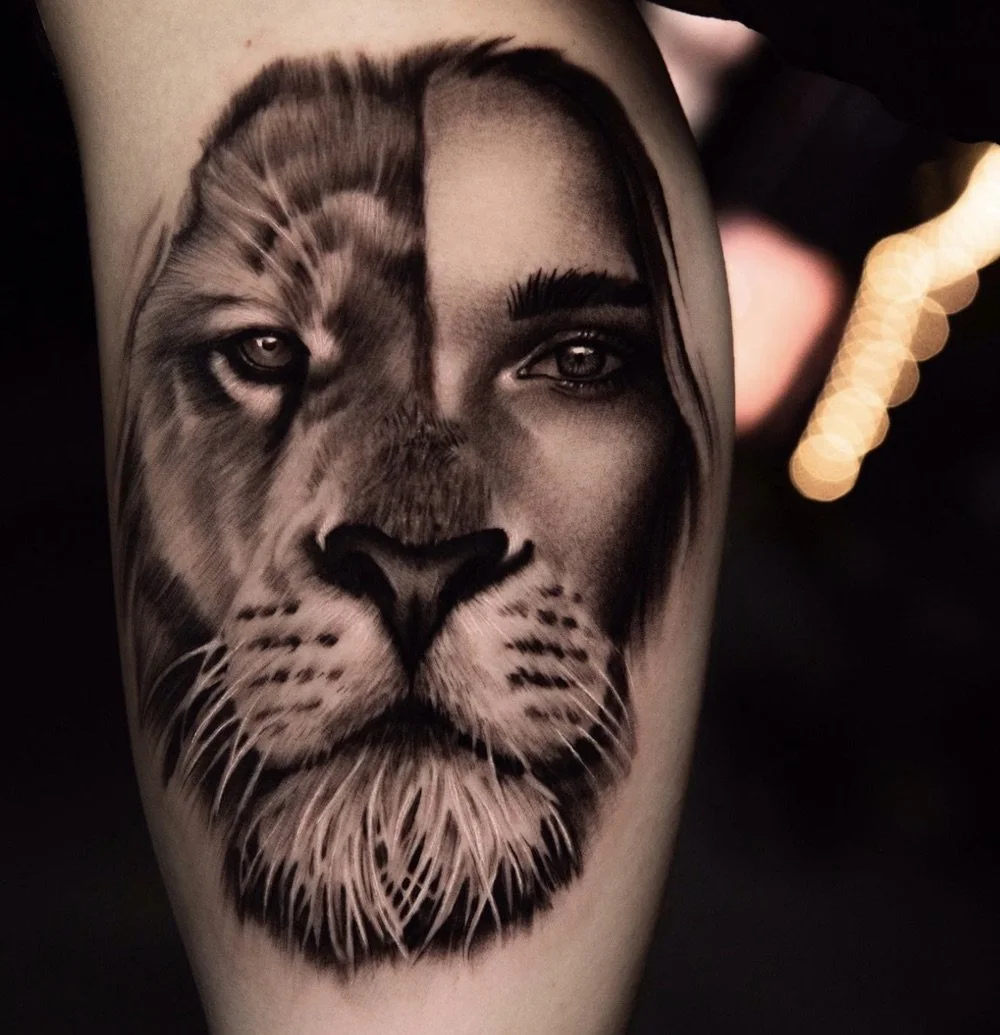
Black and grey realism split-face tattoo merging a lion and human portrait with detailed eye work by Brian Parrillo Durham NC
Why Placement Affects Eye Detail
Even a perfectly executed eye tattoo can lose impact over time if placement isn't considered carefully. Flat areas of skin — outer forearm, upper arm, thigh, calf — preserve fine detail and proportions most reliably. Areas with significant curvature or frequent movement can distort the subtle relationships between elements that make an eye read correctly.
Size matters too. Eyes reward scale. The larger the canvas, the more room to build the layers of shading that create depth. Compressing a realism eye into a very small space is possible, but it demands a level of micro-detail control that narrows the field of artists who can execute it well.
What Brian's Clients Consistently Notice
The feedback Brian hears most often about his eye work comes down to two things: soul and wetness. Not just that the eyes look accurate, but that they look alive — that there's something behind them. That quality isn't an accident. It comes from years of drawing and painting eyes before ever picking up a tattoo machine, and from a fine art background that trained his eye to see the difference between a surface that reads as flat and one that reads as dimensional.
You can see examples of this across his eye portrait tattoo portfolio, as well as throughout his human portrait and pet portrait work, where eyes consistently anchor even the most complex compositions.
If You're Considering an Eye Portrait Tattoo
The most important things to bring to a consultation: a high-quality reference photo, a realistic sense of scale, and an understanding that this subject rewards working with an artist who has done it many times before.
Brian is based at Ethereal Tattoo Gallery on Rigsbee Ave in Durham, NC, and works with clients throughout the Triangle and across North Carolina. If you're ready to talk through a project, booking information is here.
Written by Brian Parrillo — Tattoo artist with 11+ years of experience specializing in black and grey realism, portrait tattoos, and pet portrait tattoos at Ethereal Tattoo Gallery, Durham, NC. Featured in the Raleigh News & Observer. Learn more about Brian →